Se afișează postările cu eticheta Slovacia. Afișați toate postările

marți, 9 iunie 2026

O nouă monedă comemorativă din Slovacia - 09.06.2026

Utilizați butonul de Translate din dreapta pagini pentru traducere.

On June 15, Slovakia will put into circulation a new commemorative 2 euro coin dedicated to the 50th anniversary of Czechoslovakia's victory in the 1976 European Championship, one of those sporting feats that have stood the test of time to become a legend. 


The coin commemorates a triumph that belongs to the shared history of Czechoslovakia, but which Slovakia now reclaims from within the euro with an issue that is especially attractive to collectors, football fans and lovers of coins with a strong symbolic charge.

The final of that European Championship was played on June 20, 1976, in Belgrade. Czechoslovakia faced the powerful West Germany, the reigning European and world champions. The match ended in a 2-2 draw and was decided in a penalty shootout. It was there that one of football's most memorable moments was born: Antonín Panenka 's soft, chipped penalty down the middle, which gave Czechoslovakia the title and forever christened a particular style of penalty kick.

Half a century later, Slovakia commemorates that victory with a 2-euro coin that doesn't depict Panenka literally, but rather the spirit of that triumph: a right-profile footballer dribbling the ball, flanked by two laurel branches, a classic symbol of victory. Next to the figure is the inscription “MAJSTRI EURÓPY 1976”, which can be translated as “European Champions 1976”.


At the bottom is the name of the issuing country, SLOVENSKO, along with the year 2026. Also appearing are the initials MH, corresponding to the designer Matěj Hanuš, and the mint mark of the historic Kremnica Mint, one of the oldest numismatic institutions in Europe.

The issue will have a large mintage of 995,000 coins for circulation, plus an additional 5,000 proof coins, presumably intended for the collectors' market. This makes it an accessible coin, but with added appeal for those seeking more beautifully presented or higher-quality versions.

Beyond its technical specifications, this piece has a special appeal: it unites two worlds that often ignite similar passions: football and numismatics. It doesn't simply commemorate a sporting anniversary; it recaptures a moment that changed the language of football. Since 1976, saying "to take a Panenka penalty" immediately evokes a blend of composure, technique, and daring.

For collectors of commemorative €2 coins, the 2026 Slovakian coin has another point of interest: it joins the long list of European issues dedicated to major historical, cultural, and sporting events, but it does so with a theme of enormous popular recognition. You don't need to be a Central European football expert to understand the significance of that penalty kick. The "Panenka" is part of the sport's collective memory.

Slovakia has chosen a simple, direct, and highly legible design. The footballer, the ball, and the laurel wreaths encapsulate the message without cluttering the design. The coin doesn't aim to reproduce a specific scene from the final, but rather to summarize in a single image the pride of a victory that remains alive even today.

On June 15, when this new €2 coin begins its journey, it won't just be another piece added to collectors' albums. It will also be a reminder of a night in Belgrade when Czechoslovakia challenged a world champion and won with one of the most audacious gestures ever seen in a final.


Slovakia commemorative 2 euro coins

Commemorative 2 euro coins 2026


Sursa informațiilor aici.

luni, 16 martie 2026

O nouă monedă comemorativă din Slovacia - 16.03.2026

Utilizați butonul de Translate din dreapta pagini pentru traducere.

On March 17, 2026, the National Bank of Slovakia will issue a new 5-euro collector coin dedicated to the European pond turtle (Emys orbicularis), an emblematic species of the country's wetlands. The coin is part of the "Fauna and Flora of Slovakia" numismatic series, a program that for several years has highlighted animals characteristic of Slovakia and aims to bring the country's biodiversity closer to the public through numismatics.

This series has established itself as one of the most appealing collections in contemporary European numismatics, combining the artistic interest of the coins with a significant educational and environmental component. Each issue is dedicated to a specific species, highlighting both its ecological value and the need to protect its natural habitat. This time, the spotlight falls on the European pond turtle, the only native turtle species that lives naturally in Slovakia.


Design of the 5 euro coin European pond turtle


The coin was designed by artist Karol Ličko, whose proposal won the competition organized by the National Bank of Slovakia. The design seeks to reflect both the turtle's distinctive appearance and its natural environment, recreating scenes that evoke the ecosystems of lagoons and wetlands where this species finds refuge.


The obverse features a detailed depiction of a European pond turtle seen from a slightly elevated frontal perspective, creating a sense of movement as the animal moves through its environment. Below the main figure is a water lily in full bloom, a characteristic wetland plant that reinforces the natural context of the scene. The background also incorporates aquatic vegetation and reeds, elements that complete the composition and evoke the species' typical habitat. The overall effect conveys the close relationship between the turtle and the calm water ecosystem in which it lives.


The reverse side depicts an underwater scene of two turtles swimming beneath the surface, surrounded by small bubbles that accentuate the sense of depth and movement. The composition clearly shows the shape and pattern of the plastron, the lower part of the shell, whose markings are unique to each individual and function almost like an identifying fingerprint. The design realistically portrays the behavior of these reptiles in their aquatic environment, while also highlighting the species' most distinctive biological characteristics.


Technical characteristics of the coin

Feature Detail 

Country Slovakia
Issuing Authority National Bank of Slovakia
Series Fauna and Flora in Slovakia
Year 2026
Date of issue March 17, 2026
Face value 5 euros
Designer Karol Ličko
Metal Brass
Diameter 34 mm
Weight 19.10 g
Quality BU
Print run 55,000 (initially, with the possibility of increasing the amount)


Sursa informațiilor aici.

luni, 5 ianuarie 2026

O nouă monedă comemorativă din Slovacia - 05.01.2026

Utilizați butonul de Translate din dreapta pagini pentru traducere.

From January 13, 2026, Spaniards—and all citizens of the eurozone—will be able to find a special coin in their change: a Slovak 2 euro piece issued to celebrate Trenčín being the European Capital of Culture 2026.

As with all commemorative coins of this value, it is not an object exclusively for collectors: the coin will be legal tender throughout the eurozone, which means that it will circulate among us like any other, carrying the name of the Slovakian city into millions of European hands.

The selection of Trenčín to hold the title is, in itself, a recognition of the cultural strength of this historic city. Located in western Slovakia and crowned by an imposing medieval castle, Trenčín has been committed to creativity, the arts, and urban revitalization for years. The issuance of a special coin amplifies this message and makes the celebration tangible and everyday.


The official design description is meticulous. At its center is the stylized silhouette of Trenčín Castle, the city's undisputed symbol. The artist, Klára Fojtů, who created the design, uses it as the central axis around which various cultural icons are arranged: a palette and paintbrush, a film camera, and classic theatrical masks. Each element adds a different layer to the artistic world that Trenčín aims to showcase to the rest of Europe during its year as a European Capital of Culture.

The name TRENČÍN appears integrated into the composition, along with the year 2026. We also find the mark of the historic Kremnica Mint, represented by the letters MK between two dies, a signature that has accompanied the monetary issues of the Slovak territory since the 14th century.

At the bottom of the coin is the legend “EURÓPSKE HLAVNÉ MESTO KULTÚRY” (“European Capital of Culture”), and at the top, the name of the country: SLOVENSKO. The outer ring maintains the twelve stars of the European Union, as on all 2 euro coins.

The mintage of this coin is 1 million pieces, of which 5,000 will be Proof quality.

Even the edge is personalized: it is engraved with "SLOVENSKÁ REPUBLIKA" between two stars and a small linden leaf, one of the national symbols of Slovakia.

Beyond its monetary function, this coin acts as a miniature cultural ambassador. The idea that a citizen of Cádiz, Barcelona, ​​or Bilbao might receive a coin celebrating Trenčín's cultural year as change perfectly reflects the European spirit: thousands of stories, identities, and traditions circulating freely among us.

For Slovakia, the coin represents an opportunity to highlight its heritage and creative scene. For the European Union, it is a reminder of how culture can unite diverse countries, becoming a common language. And for collectors, it will undoubtedly be a coveted piece, not only for the beauty of its design, but also for the significance of the event it commemorates.


Slovakia commemorative 2 euro coins

Commemorative 2 euro coins 2026


Sursa informațiilor aici.

duminică, 28 septembrie 2025

O nouă monedă comemorativă din Slovacia - 28.09.2025

Utilizați butonul de Translate din dreapta pagini pentru traducere.

The Bank of Slovakia (Národná banka Slovenska) has recently issued a new commemorative silver coin with a face value of 20 euros. The coin, issued on September 23, pays tribute to one of the country's most valuable natural environments: the protected landscape of the Danube floodplains.


Danube floodplains


The Danube Floodplains (Slovak: Dunajské luhy) constitute one of the largest and most valuable alluvial wetland ecosystems in Central Europe, closely linked to the Gabčíkovo Hydraulic Complex on the border between Slovakia and Hungary. This region is home to the Danube Inland Delta, a geomorphological uniqueness in the heart of the continent.

The biotopes of the area's floodplains and wetlands are the result of the constant dynamics between surface and groundwater. This natural process has preserved the original features of the landscape, which today hosts a great diversity of plant and animal species, many of which depend on this unique habitat.

This distinctive landscape is an exceptional example of the interaction between humans and nature. Today, it requires not only protection but also active management, including specific water management and forestry measures to improve the conditions for the flora and fauna of the fragile ecosystems. To preserve and enhance its exceptional natural heritage, the area was designated the Dunajské luhy Protected Area on May 1, 1998.


The upper half of the obverse depicts a Eurasian beaver sitting on a river bank in the natural setting of a floodplain forest. The lower half depicts two different species of fish found in the Danube floodplains: the sturgeon and the common carp. On the left, below the beaver, appears the name of the issuing country, "SLOVENSKO" (SLOVAKIA), and below it, the year of issue, "2025." The coat of arms of Slovakia also appears on the right side of the composition.


The reverse of the coin features a little egret among reeds in rippling water, with two kingfishers perched on a branch above it. On the left side, between the egret and the branch, is the coin's face value, "20 EURO." The inscription "CHRÁNENÁ KRAJINNÁ OBLASŤ" (Slovak for "Protected Landscape Area") runs along the top left edge of the design, while the name "DUNAJSKÉ LUHY" ("Danube Floodplains") appears along the bottom right edge. To the right of the heron are the mintmark of the Kremnica Mint (Mincovňa Kremnica), the letters "MK" between two dies, and next to them are the stylized initials "KL" of the designer, Karol Ličko.

Technical characteristics

Designer: Karol Ličko
Metal: 925 silver, 75 copper
Weight: 33.63 g
Diameter: 40 mm
Country: Slovakia
Mint: Mincovňa Kremnica
Engraver: Jakub Morávek
Issue volume: 5,000 BU / 10,300 Proof


Sursa informațiilor aici.
marți, 22 iulie 2025

O nouă monedă comemorativă din Slovacia - 22.07.2025

Utilizați butonul de Translate din dreapta pagini pentru traducere.

Coin collectors now have a new date for 2027. Slovakia has announced the release of a commemorative 2-euro coin dedicated to the 250th anniversary of the Ratio educationis , a fundamental milestone in the history of education in Central Europe.

Although details such as the circulation, the final design, or whether special collector's versions will be issued are still unknown, we do know that this piece will be released in August 2027 and will become a symbol of the commitment to education and intellectual progress in the former Hungary, of which Slovakia was a part.


What was the Ratio educationis?


To understand the importance of this currency, it is necessary to go back to the 18th century, in the midst of the era of enlightened reforms.

Fantasy design, property of Numismatics Visual


In 1777, under the reign of Empress Maria Theresa of Austria , a highly significant document was promulgated in the Kingdom of Hungary: the Ratio educationis . This text established for the first time a legal framework for the organization of education in the territory, including present-day Slovakia.

Its objective was to modernize the education system, guarantee access to education, and create a uniform structure of primary, secondary, and higher education. Among other things, the Ratio educationis :

– Regulated curricula and teacher training.
– Promoted the creation of new schools in rural areas.
– Established state supervision over education, limiting the exclusive influence of the Church.

It was a pioneering measure for its time, which sought to educate the population and provide them with practical and scientific knowledge.


An illustrated legacy


The Ratio educationis reflected the ideals of the Enlightenment: faith in reason, in education as an engine of progress, and in the role of the State as guarantor of the common good.

Although it was not without resistance (especially from ecclesiastical circles), this decree laid the foundation for the evolution of educational systems in Central Europe. Its influence was felt for generations, contributing to the cultural and social development of the peoples that now make up Slovakia.


A coin to commemorate a milestone


Slovakia's future commemorative 2-euro coin will be much more than a collector's item: it will be a tribute to the value of education and the efforts to bring knowledge to all corners of society.

Although we don't yet know what the design will look like, it likely includes educational symbols such as books, pens, or school buildings. It could also allude to the Enlightenment spirit of the time and Maria Theresa's role as a promoter of this reform.


A message for the present


At a time when access to education remains a challenge in many parts of the world, this coin commemorates how knowledge and education were conceived as tools of emancipation and social progress as early as the 18th century.

For collectors and history buffs, this €2 coin promises to be an object of profound cultural significance, as well as numismatic appeal.


Slovakian commemorative 2 euro coins


Sursa informațiilor aici.

luni, 16 iunie 2025

O nouă monedă comemorativă din Slovacia - 16.06.2025

Utilizați butonul de Translate din dreapta pagini pentru traducere.

On June 16, the National Bank of Slovakia will issue a new silver collector coin with a face value of 20 euros, dedicated to the Kežmarok Heritage Site. This town in eastern Slovakia is home to the Evangelical Stave Church, declared a UNESCO World Heritage Site in 2003 as part of the Carpathian Wooden Churches.

Kežmarok is located in the Poprad River basin, between the High Tatra and Belianske Tatra Mountains. Its history dates back to the Middle Ages, when it grew as a strategic point at the intersection of trade routes. In 1269, it received its town charter from King Béla IV of Hungary. It was fortified in the 14th century, and in the 15th century, during the reign of Sigismund, it underwent a major transformation: the Basilica of the Exaltation of the Holy Cross was rebuilt, the foundations of the town hall were laid, and a low-lying castle was built.

A major fire in 1521 destroyed more than 300 houses, prompting a reconstruction phase that included a Renaissance bell tower and a gymnasium. In the 17th century, the Church of the Visitation of the Blessed Virgin Mary was built, and during the Baroque period, the wooden Lutheran church, the Lutheran high school with its library, the Reduta building, and a renovated town hall were added. In 1892, the New Lutheran Church was added, becoming one of the city's symbols. The Kežmarok Historical Complex, which includes the castle, the Lutheran churches, and the high school, was declared a national heritage site in 1950.


The new coin captures this rich history in its design. The obverse features a panorama of Kežmarok, with its most iconic buildings in the foreground and the Tatra Mountains in the background. The inscription "SLOVENSKO" appears at the top, along with the year of issue, "2025." The lower part features the denomination "20" and the word "EURO" on either side of the Slovak coat of arms.


The reverse depicts an architectural relief composition over the decorative outline of the castle. The Basilica of the Holy Cross appears in the foreground, with the townhouses, the town hall tower, and the New Lutheran Church in the background. The upper part reads "KEŽMAROK," and below the image, in two lines, the inscription "PAMIATKOVÁ REZERVÁCIA." On the left is the city's coat of arms; on the right are the stylized initials of the designer, Karol Ličko, "KL." Next to the basilica tower is the mintmark of the Kremnica Mint, with the letters "MK" between two dies.

This issue is part of the Slovak Central Bank's efforts to highlight sites and monuments of historical and cultural value in the country.

Currency specifications

Designer: Karol Ličko
Metal: 925 silver, 75 copper
Weight: 33.63 g
Diameter: 40 mm
Country: Slovakia
Mint: Ministry of Culture
Engraver: Dalibor Schmidt
Issue volume: 5,000 BU / 10,800 Proof


Sursa informațiilor aici.

miercuri, 4 iunie 2025

O nouă monedă comemorativă din Slovacia - 04.06.2025

Utilizați butonul de Translate din dreapta pagini pentru traducere.

In 2026, it will be 50 years since one of the most glorious moments in Czechoslovak football: the victory at the 1976 European Championship. To commemorate this historic milestone, the National Bank of Slovakia (Národná banka Slovenska, NBS) has launched a public competition to design a commemorative 2-euro coin to celebrate this special anniversary.


A historic tribute in numismatic format


The commemorative coin will be officially issued in 2026 and will feature the Czechoslovakian national team's feat, which was crowned European champion after defeating the all-powerful West Germany in an epic penalty shootout. The most memorable moment of the tournament was Antonín Panenka's masterfully converted penalty, which gave rise to a technique immortalized in his name.

What makes this victory especially significant from a Slovak perspective is that eight of the starting eleven in the final were Slovak, including names such as Anton Ondruš, Karol Dobiaš, Ján Švehlík, and Jozef Móder. Goalkeeper Ivo Viktor was named the tournament's best player, and five other members of the team were included in the All-Slovak Championship XI.


The rules of the design competition


The competition announced by the NBS is an anonymous and open call for artists, designers, and sculptors, who must submit proposals for the design of the national side of the coin. The design must comply with the technical regulations for 2-euro coins, which include a bimetallic structure with a gold center and silver-plated outer ring, as well as the mandatory placement of twelve European stars on the ring.


Mandatory elements that must appear in the design include:

The name of the country: “SLOVENSKO”

Year of issue: “2026”

The text: “Majstri Európy 1976” (“European Champions 1976”)


Motifs related to triumph, such as the cup, a vintage soccer ball, or players celebrating victory.

Designs may not contain political elements or messages that could be associated with political parties or ideologies.

Dates and awards

Participants have until September 16, 2025, to submit their proposals, which must be submitted as a plaster model or digital format according to the technical requirements established by the NBS. The models must clearly indicate the separation between the core and the outer ring of the coin.

Cash prizes have been established for the best designs:

1st prize: €2,500

2nd prize: €2,000

3rd prize: €1,500

In addition, additional prizes totaling €4,000 may be awarded.

The creator of the design ultimately selected for minting will also receive an additional fee of €1,250 for licensing and collaboration in the coin's production process.

A symbol of national identity

The creation of this commemorative coin not only pays tribute to a brilliant chapter in Czechoslovakia's sporting history but also celebrates Slovakia's crucial contribution to that feat. In a current context where shared history is intertwined with individual national identities, this initiative becomes a symbol of national pride and historical legacy.

The public and coin collectors will be able to enjoy this special edition in 2026, half a century after Czechoslovakia emerged as European continental champion, with Slovakia as a silent but key player.


Sursa informațiilor aici.

miercuri, 14 mai 2025

O nouă monedă comemorativă din Slovacia - 14.05.2025

Utilizați butonul de Translate din dreapta pagini pentru traducere.

As part of the "Fauna and Flora in Slovakia" collector coin series, the National Bank of Slovakia will issue a new coin dedicated to the Eastern Imperial Eagle on May 19.


Known as the majestic queen of the plains, the eastern imperial eagle is the rarest eagle species found in Slovakia. Despite what its name suggests, it is not the largest in the country, but it is one of the most unique. Its presence in Slovakia dates back to the mid-20th century, when it began expanding from the steppes of southern Europe. It is easily distinguished from other eagles by two striking white spots on its wings.

These birds build their nests in tall trees. The female lays between one and three eggs, which hatch after an incubation period of 43 to 45 days. The eaglets leave the nest 70 to 75 days after birth. Initially, the male is responsible for feeding the young, but as they grow, the female also participates in their feeding.

Their diet consists primarily of small rodents, young hares, pheasants, partridges, and corvids. In Slovakia, where there are an estimated 100 breeding pairs, the eastern imperial eagle is protected by law. This makes the country a key location for conservation efforts for this iconic species in Europe.


The obverse shows, on the left, an Eastern Imperial eagle perched on a branch and, on the right, an eagle in flight with its wings spread. The coat of arms of Slovakia appears in the upper right corner of the design, just below the year of issue "2025." The name of the issuing country, "SLOVENSKO," is inscribed on the upper edge. The coin's denomination and mintage, "5 EURO," are located in the lower right corner, below the eagle in flight. To the left of the perched eagle is the mintmark of the Kremnica Mint (Mincovňa Kremnica), composed of the letters "MK" between two dies.


The reverse features the head of an Eastern Imperial eagle, which occupies most of the design. Below, on the eagle's neck, is a nest with two eaglets and an egg. The scientific and Slovak names of the Eastern Imperial Eagle, "Aquila Heliaca" and "Orol KraĽovskÝ," are inscribed in the border surrounding the eagle's head. The stylized initials "TL" of the designer, Tomáš Lamač, appear along the lower right border.

Technical characteristics

Designer: Tomáš Lamač
Metal: Brass
Weight: 19.1 g
Diameter: 34 mm
Country: Slovakia
Mint: Ministry of Culture
Engraver: Dalibor Schmidt
Issue volume: 55,000 (initially, with the possibility of increasing the amount)


Sursa informațiilor aici.

marți, 18 martie 2025

O nouă monedă comemorativă din Slovacia - 18.03.2025

Utilizați butonul de Translate din dreapta pagini pentru traducere.

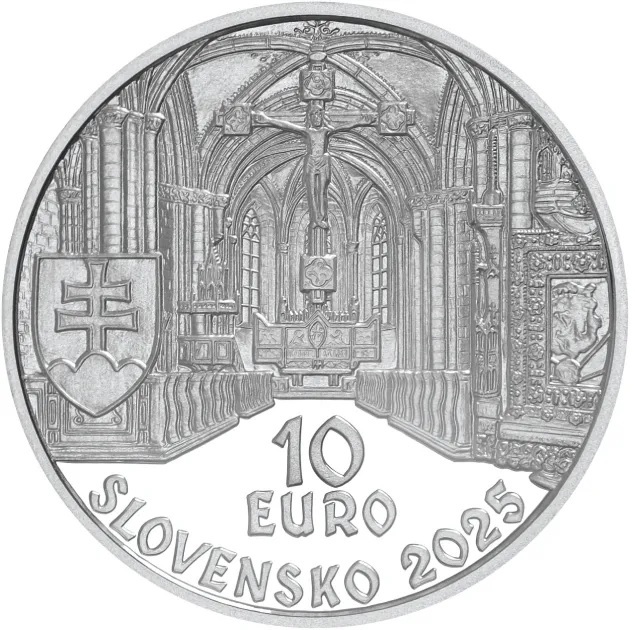
On March 17, the Bank of Slovakia issued a collector's coin with a face value of €10. This coin commemorates the 950th anniversary of the founding of the Benedictine Abbey of Hronský Beňadik, a municipality in the Žarnovica district of the Banská Bystrica region of Slovakia.

The Benedictine Abbey of Hronský Beňadik is a complex of fortified sacred buildings founded in 1075 by King Géza I of Hungary, who intended to establish an influential religious institution renowned throughout Hungary. During the period of high feudalism, the Abbey of St. Benedict served as a model for teaching farming and the cultivation of agricultural crops. The Benedictines were also skilled in metallurgy and construction.

The importance and indispensable role of the abbey in feudal society arose from its function as a "locus credibilis," a place where legal documents could be authenticated. The abbey is considered a possible source of the "Nitra Gospel" (Nitriansky evanjeliár), the oldest book in Slovakia.

The abbey complex represents a symbiosis of diverse architectural styles, from Gothic and Renaissance to Baroque, and still stands imposingly over what was once an important commercial crossroads. It was also declared a World Heritage Site on April 24, 1970.


The obverse of the coin depicts a depiction of the interior of the Benedictine abbey church in the municipality of Hronský Beňadik, with Gothic columns on either side and a large crucifix in the upper center. A reliquary containing a relic of the Blood of Christ is incorporated into the right side of the design, while the Slovak coat of arms covers part of the left side. The name of the issuing country "SLOVENSKO" (SLOVAKIA) and the year of issue "2025" are inscribed on the lower edge, and just above these is the face value "10 EURO."


On the other hand, the reverse of the piece shows a top-down view of the fortified abbey complex, with the figure of Saint Benedict on the right. The inscription "OPÁTSTVO SV. BENEDIKTA" (Abbey of Saint Benedict) surrounds the top edge of the composition, while the top left corner bears the year of the abbey's foundation, "1075," and at the bottom of the central design, the inscription "HRONSKÝ BEŇADIK," framed by bunches of grapes. In the lower right corner is the mintmark of the Kremnica Mint (Mincovňa Kremnica), consisting of the letters "MK" sandwiched between two dies, and beneath it, the stylized initials "TL," the mark of the designer, Tomáš Lamač.

Technical characteristics

Year: 2025
Face value: 10€
Country: Slovakia
Metal: 900 Silver
Weight: 18 g
Diameter: 34 mm
Design: Tomáš Lamač
Mint: Ministry of Culture
Engraver: Dalibor Schmidt
Issue volume: 4,900 BU and 10,700 Proof


Sursa informațiilor aici.

luni, 24 februarie 2025

O nouă monedă comemorativă din Slovacia - 24.02.2025

Utilizați butonul de Translate din dreapta pagini pentru traducere.

Slovakia 10 euro 2025 - 950th anniversary of the founding of the Benedictine abbey in Hronské Beňadik

New silver collectors' type to be issued soon:

"950th anniversary of the founding of the Benedictine abbey in Hronské Beňadik"

TECHNICAL DATA

Composition: silver .900
Diameter: 34.00 mm
Weight: 18.00 g
Artist: Tomáš Lamač
Mint: Mincovňa Kremnica (Slovakia)


LINK: Mincovňa Kremnica


Sursa informațiilor aici.

marți, 21 ianuarie 2025

O nouă monedă comemorativă din Slovacia - 21.01.2025

Utilizați butonul de Translate din dreapta pagini pentru traducere.

Slovakia 2 euro 2025 - 100th anniversary of the first international sports tournament in the territory of the Slovak Republic – the Ice Hockey European Championship

New bimetallic circulating commemorative:

"100th anniversary of the first international sports tournament in the territory of the Slovak Republic – the Ice Hockey European Championship"


TECHNICAL DATA

External ring: copper-nickel
Center disc: nickel-brass, nickel and nickel-brass three layers
Diameter: 25.75 mm
Weight: 8.50 g
Thickness: 2.20 mm
Designer: Karol Ličko
Mintage: 1 million
Mint: Mincovňa Kremnica (Slovakia) 


Sursa informațiilor aici.

marți, 31 decembrie 2024

O nouă monedă comemorativă din Slovacia - 31.12.2024

Utilizați butonul de Translate din dreapta pagini pentru traducere.

Continuing the series of collector's items "Fauna and Flora in Slovakia", the National Bank of Slovakia issued a new coin in this series on October 8, which features the common capercaillie or western capercaillie.

Western grouse (Tetrao urogallus)

The western capercaillie is one of the largest bird species in Slovakia. The male is black except for a metallic blue-green sheen on the breast and brown wings with a white patch. The feathers under the beak are elongated and prominent, and above each eye there is a bright red patch of skin. The relatively long, black tail feathers have whitish patches and widen at the tip. The female is plainer, with mottled chestnut-brown plumage and a striking rust-coloured patch on the breast. The young are similar in appearance to the hen, although with somewhat less pronounced mottling.

In Slovakia, the western capercaillie is found in coniferous and mixed forests, at altitudes of between 600 and 1,550 metres above sea level. The species thrives in scattered strips of old, primeval mountain forest. The capercaillie nests on the ground, in a shallow depression lined with dry leaves, twigs and blades of grass or pine needles. Egg laying occurs in April–May, with the female typically laying six to nine yellowish-brown, speckled eggs.

In winter and early spring, the western capercaillie feeds almost exclusively on pine needles, shoots and buds, while in summer its diet extends to various berries and plant leaves, plus an animal component consisting mainly of insects. This bird is a solitary creature, except when the two sexes come together in the mating season. During courtship, the male stands with its tail feathers raised and fanned out, its neck erect and its beak pointing skywards, and it is a protected species in Slovakia.
 

The obverse of the coin shows a male western capercaillie in a heathland setting, together with a female of the same species at the bottom right of the design. In the background we see coniferous trees and an upright, splintered tree trunk. The coat of arms of Slovakia appears on the right side of the design, below the face value “5 EURO”. On the upper edge are inscribed the name of the issuing country and the year of issue: “SLOVENSKO” (SLOVAKIA), “2024”. While on the right edge is the mint mark of the Kremnica Mint (Mincovňa Kremnica), consisting of the letters “MK” placed between two dies.
 

Finally, the reverse of the coin is dominated by the image of a male western capercaillie perched on a branch. The Slovak name for the species, “HLUCHÁŇ HÔRNY”, is inscribed on the lower edge of the design, while the scientific name, “TETRAO UROGALLUS”, appears on the upper left edge. To the right of the bird is the tip of a pine branch with a pine cone, next to which are the stylised letters “TL”, referring to the coin’s designer, Tomáš Lamač.


Technical characteristics

Designer: Tomas Lamac
Metal: Brass
Weight: 19.1 g
Diameter: 34 mm
Country: Slovakia
Mint: Minsk, Kremnica
Engraver: Dalibor Schmidt
Issue volume: 50,000 (initially, with the possibility of increasing the amount) 


Sursa informațiilor aici.

vineri, 20 decembrie 2024

O nouă monedă comemorativă din Slovacia - 20.12.2024

Utilizați butonul de Translate din dreapta pagini pentru traducere.

The Bank of Slovakia has released new information and images of the commemorative 2 euro coin that it will issue on 20 January under the name “100th Anniversary of the First International Sports Tournament in Slovakia – European Ice Hockey Championship”.

In 1925, the European Ice Hockey Championship was held in Štrbské Pleso / Starý Smokovec in what was then Czechoslovakia, which was also the winner of the tournament, a competition in which only four countries participated: Austria, Belgium, Switzerland and Czechoslovakia.

The design of the coin, as in other cases, was born from a competition organized by the Bank of Slovakia. Ten creative proposals from eight authors were submitted to the competition, and the one proposed by Karol Liček was chosen.


The design is dominated by the figure of a hockey player in motion. The background of the landscape is divided into a horizontal strip of vegetation, and above it stand the Tatra Mountains, which are divided into two parts by the silhouette of the player.


The Slovak Mint, Mincovňa Kremnica, has minted one million of these coins, of which, except for 5,000 in Proof quality, the rest are intended for circulation. The announced issue date is 20 January 2025.

Slovakia 2 euro commemorative coins

2 euro commemorative coins 2025


Sursa informațiilor aici.

joi, 28 noiembrie 2024

O nouă monedă comemorativă din Slovacia - 28.11.2024

Utilizați butonul de Translate din dreapta pagini pentru traducere.

On December 5, a collector's coin will be issued in Slovakia dedicated to the tradition of blue dyeing (dyeing or printing in indigo blue). It was inscribed on the UNESCO Representative List of the Intangible Cultural Heritage of Humanity in 2018, as part of a multinational nomination submitted by Slovakia, Germany, Austria, the Czech Republic and Hungary.

Blue dyeing ('modrotlač' in Slovak) is a handcrafted process in which a pattern is applied to fabric using a block to print a dye-resist paste, called Papp, onto the fabric before it is dyed with indigo. Originally an oriental method of fabric decoration, it became an important part of Slovak and European textile traditions. It was adopted in Slovak rural areas in the 19th century, becoming an important part of folk dress and home textiles. Compared to other central European countries, Slovakia maintained considerable regional diversity in blue-dyed patterns and a high density of blue-dyeing workshops until the mid-20th century. While rural blue dyeing gradually declined, interest in the practice has recently grown among fashion designers.


The right side of the obverse depicts a craftsman using a handmade wooden block to create a pattern for dyeing fabric blue. To the left is the floral side of another block, and to the top right of the design are three pieces of fabric hung after being dyed. Between the craftsman and the floral motif are the coin denomination “100” and the coin “EURO”, one on top of the other. Below the craftsman is the year of issue “2024” and to the right is the coat of arms of Slovakia. The name of the issuing country “SLOVENSKO” is inscribed at the bottom of the design. In the bottom left corner of the block pattern is the mint mark of the Kremnica Mint (Mincovňa Kremnica), consisting of the letters “MK” placed between two dies; in the bottom right corner are the stylised initials “KL” of the designer, Karol Ličko.


The reverse motif is divided into two vertical halves. On the top left is the Slovak word MODROTLAČ, meaning dyed blue, with its morphemes divided one above the other. Below it, in descending order, are the words NEHMOTNÉ, KULTÚRNE and DEDIČSTVO, meaning intangible cultural heritage in Slovak. On the right side is a hanging blue-dyed cloth with the same floral pattern as the obverse motif, together with additional horizontal decoration above and below the motif.


Designer Karol Ličko
Composition 900 gold .75 silver .25 copper
Weight 9.5 grams
Diameter 26 millimeters
Singing Fluted
Coinage Kremnica Mint
Engraver Dalibor Schmidt
Issue volume 5,600 all in Proof quality
Issue date December 5, 2024


Sursa informațiilor aici.

vineri, 25 octombrie 2024

O nouă monedă comemorativă din Slovacia - 25.10.2024

Utilizați butonul de Translate din dreapta pagini pentru traducere.

Another coin from the “Fauna and Flora in Slovakia” collection was issued on July 2 by the National Bank of Slovakia, this time featuring the majestic European bison.

The bison is the largest land mammal in Europe, and is built similar to cattle. It has a relatively short, rounded head and is covered with brown hair from head to tail. The forequarters are more voluminous than the hindquarters and are accentuated by longer hair. The strong, hollow horns are a permanent feature of both sexes and grow with age.

Bison are most active at dusk, and their vision has adapted accordingly. Their most developed senses are hearing and smell. They can live up to 35 years. They are social animals, usually living in herds of 8 to 13 animals, although older males tend to be solitary. They feed mainly on green and woody plant matter, such as branches, bark and leaves. They prefer young forests with a dense undergrowth, and in winter, their staple food is brambles, tree bark, shrubs and dry grass, which they dig up from under the snow.

Historically, bison ranged across almost all of Europe. In Slovakia, around 70 bison live in the wild in a reserve in the Poloniny National Park.


The obverse of the coin depicts a male European bison with trees in the background and drooping branches. The coat of arms of Slovakia appears at the bottom right of the design, just below the year of issue “2024”. The name of the issuing country “SLOVENSKO” is inscribed along the left edge. While at the bottom of the design is the mint mark of the Kremnica Mint (Mincovňa Kremnica), consisting of the letters “MK” placed between two dies, and next to it, the stylised letters “KL”, referring to the coin’s designer, Karol Ličko.


On the other hand, the reverse of the coin shows the head of a European bison next to a beech branch with leaves and nuts. Above these is the face value of the coin “5 EURO”, and on the top left edge, the Slovak name of the European bison “ZUBOR HRIVNATÝ”, while on the bottom left we see the scientific name “BISON BONASUS”.

Technical characteristics

Designer: Karol Ličko
Metal: Brass
Weight: 19.1 g
Diameter: 34 mm
Country: Slovakia
Mint: Minsk, Kremnica
Engraver: Dalibor Schmidt
Issue volume: 50,000 (initially, with the possibility of increasing volume)


Sursa informațiilor aici.

miercuri, 2 octombrie 2024

O nouă monedă comemorativă din Danemarca - 02.10.2024

Utilizați butonul de Translate din dreapta pagini pentru traducere.

Slovakia 5 euro 2024 - Fauna and flora: Western capercaillie

New commemorative type:

"From the series Fauna and flora in Slovakia: Western capercaillie (Tetrao urogallus)"

TECHNICAL DATA

Composition: brass
Diameter: 34.00 mm
Weight: 19.10 g
Mint: Mincovňa Kremnica (Slovakia)


(image from www.mint.sk)

LINK: Mincovňa Kremnica


Sursa informațiilor aici.

vineri, 20 septembrie 2024

O nouă monedă comemorativă din Slovacia - 20.09.2024

Utilizați butonul de Translate din dreapta pagini pentru traducere.

Slovakia 2 euro 2024 - 100th anniversary of the Košice International Marathon

New bimetallic circulating commemorative:

"100th anniversary of the Košice International Marathon"


TECHNICAL DATA

External ring: copper-nickel
Center disc: nickel-brass, nickel and nickel-brass three layers
Diameter: 25.75 mm
Weight: 8.50 g
Thickness: 2.20 mm
Mint: Mincovňa Kremnica (Slovakia)


Sursa informațiilor aici.

miercuri, 18 septembrie 2024

O nouă monedă comemorativă din Slovacia - 18.09.2024

Utilizați butonul de Translate din dreapta pagini pentru traducere.

Last June, a new collector coin was issued by the National Bank of Slovakia to commemorate the 300th anniversary of the birth of Brother Cyprian of the Red Monastery.

Franz Ignác Jäschke, also known as Brother Cyprian of the Red Monastery, was a Cistercian monk who lived in the region of Bohemia (now part of the Czech Republic) during the 18th century. He is best remembered for his connection to the mystical and occult movements of the time. Jäschke was one of the most prominent members of the Red Monastery, a place associated with esoteric practices within the religious sphere.

Brother Cyprian gained some fame for his knowledge of alchemy and other occult sciences, something that was relatively common in some monastic and scholarly circles of the period. The Cistercian monks, to which he belonged, were characterized by their austere life and their dedication to prayer and manual labor, but some of them, like Jäschke, were also interested in areas of knowledge considered controversial within the Church.

The Red Monastery (Czech: Červený kláštor) is located in Slovakia, and has been shrouded in stories that mix religion and mysticism. Brother Cyprian is remembered as an apothecary or doctor who combined his knowledge of medicinal plants with alchemical practices. Legend credits him with creating powerful remedies and using occult knowledge for the good of others. One of the most popular myths is that he invented a primitive flying machine, making him a mysterious and enigmatic figure.

His life and work are intertwined with popular imagination and local legends, which portray him as a monk with almost supernatural abilities. Although little is known about him in detail, the figure of Franz Ignác Jäschke as Brother Cyprian has endured in the collective memory of the region thanks to his connection with the Red Monastery and his role within the context of mysticism and alchemy.


The obverse of the coin features an imaginary portrait of Brother Cyprian holding a basket of plants. Above the basket is a flying machine and above it is a flying eagle. Below the basket is the inscription of the year of issue “2024”, and on the left side is the Slovak coat of arms, above which is the face value “10 EURO”. The name of the issuing country, “SLOVENSKO” (SLOVAKIA), is displayed on the lower left edge of the composition.


On the other hand, the reverse of the coin features the central image of a medicinal plant presented in Brother Cyprián’s herbarium. On the right side, part of the Red Monastery is shown against the backdrop of the Three Crowns Massif, a landmark in the Pieniny Mountains. Above this image, in the upper right part of the design, are Brother Cyprián’s birth dates “1724” and death dates “1775”, placed one on top of the other. To the left of the plant are the stylised letters “RL”, referring to the coin’s designer Roman Lugár, and below is the Kremnica Mint’s mintmark, consisting of the letters “MK” placed between two dies. On the left edge there is also the inscription “FRÁTER CYPRIÁN”, and on the right – the Slovak name of the Red Monastery “ČERVENÝ KLÁŠTOR”.

Technical characteristics

Designer: Roman Lugar
Metal: 900 silver
Weight: 18 g
Diameter: 34 mm
Country: Slovakia
Mint: Minsk, Kremnica
Engraver: Jakub Moravek
Issue volume: 4,050 BU / 9,150 Proof


Sursa informațiilor aici.

marți, 20 august 2024

O nouă monedă comemorativă din Slovacia - 20.08.2024

Utilizați butonul de Translate din dreapta pagini pentru traducere.

We already have all the official information and real images about the commemorative 2 euro coin that Slovakia is issuing in 2024, a very beautiful and eye-catching coin that commemorates the anniversary of a sporting event, "Centenary of the Košice International Marathon".

The design of the coin is the result of a design competition in which the project presented by Roman Lugár was selected.


The composition of the design is dominated by a running marathoner. The place of action is indicated by a fragment of the iconic architecture of Košice – the Gothic dome. The author has condensed the marathon plot symbolized by the runner and the backdrop of the eastern Slovak metropolis of Košice.


The Slovak Mint, Mincovňa Kremnica, has minted one million of these coins, of which, except for 5,000 in proof quality, the rest are intended for circulation. The announced issue date is 19 September.

On the reason the coin is dedicated to

The Košice International Marathon, also known as the Peace Marathon, celebrates its centenary in 2024. This marathon is one of the oldest in the world, having been held for the first time in 1924. It is the oldest marathon in Europe and the second oldest in the world, second only to the Boston Marathon.

It was founded by Vojtech Braun Bukovský, a sports enthusiast and journalist, inspired by the Paris Olympics.

Since its first edition, the marathon has grown in prestige and participation. In its first race, only eight runners took part, but it quickly became an international event. In 1931, the young Argentine Juan Carlos Zabala surprised everyone by setting a record of 2:33:19, and then won the gold medal at the Los Angeles Olympics in 1932.

The marathon has continued uninterruptedly, even during the years of World War II, albeit under different flags due to the occupation of Košice. In 1980, the first women's race was held, marking another important milestone in its history.

Today, the Košice Marathon is recognised as a silver label race by World Athletics and continues to attract runners from all over the world.

To mark its centenary, several special activities have been organised, including an exhibition at the Museum of Eastern Slovakia showcasing the rich history of the event.


Sursa informațiilor aici.

miercuri, 14 august 2024

O nouă monedă comemorativă din Slovacia - 14.08.2024

Utilizați butonul de Translate din dreapta pagini pentru traducere.

A new commemorative coin has been issued by the National Bank of Slovakia and was launched on 22 May. The new coin is issued to commemorate the 250th anniversary of the birth of Jozef Dekret Matejovie, a Slovak forester who was also a great advocate of progressive ideas in forest management.

Jozef Dekret Matejovie (12 July 1774 – 18 January 1841)


Born in Dobroč near Čierny Balog, Matejovie, with experience in the forestry sector, laid the foundations for the rational management of Slovak forests and made a significant contribution to the preservation of forests. In the 19th century, wood was the main source of building material and energy for the metallurgical industry in central Slovakia, its extraction and processing were an important source of livelihood for the local population. Aware of the disastrous consequences of unregulated logging for both the environment and society, Matejovie succeeded in changing previously harmful practices.

In 1809 he initiated efforts to regenerate forest stands, established the first forest nurseries and seed banks, and put an end to clear-cutting. To promote the regeneration of natural forests and the creation of mixed stands, he moved logging to other sites. He also ensured the conservation of wood resources, for example by using waste from logging sites. Under his leadership, almost four thousand hectares of deforested land were reforested by 1838.


The left side of the reverse shows part of a tree trunk cross-section, the right edge of which resembles the left outline of a conifer. To the right of this image is a portrait of Jozef Dekret Matejovie with the dates of his birth and death “1774 – 1841” inscribed along the edge. Above the cross-section is the coin’s face value “10 EURO”, and along the left edge is the inscription “JOZEF DEKRET MATEJOVIE”.


The obverse again features a cross-section of a tree trunk with the outline of a conifer, on which a seedling is depicted. To the right of the outline, superimposed on part of the trunk, are the year of issue “2024” and the Slovak coat of arms, placed one above the other. The name of the issuing country, “SLOVENSKO” (SLOVAKIA), is inscribed on the right edge of the design. To the left of the roots of the seedling is the mintmark of the Kremnica Mint (Mincovňa Kremnica), consisting of the letters “MK” placed between two dies, and the stylised initials “MS”, referring to the coin’s designer, Martin Sabol.

Technical characteristics


Designer: Martin Sabol
Metal: 900 silver
Weight: 18 g
Diameter: 34 mm
Country: Slovakia
Mint: Minsk, Kremnica
Engraver: Dalibor Schmidt
Issue volume: 3,900 BU / 8,600 Proof


Sursa informațiilor aici.